Saturday, July 12, 2014

A Long Journey


It is getting to the point in my time here that I have to start working on the various assignments that I am required to do for my classes. For the last week or so I have been taking notes for a history essay I needed to write, with the plan that I would start it this weekend. Being that I did not want to spend the entirety of my Saturday writing a paper about Ireland’s Third Home Rule Bill, I decided that I would go to a spot in Dublin that I have wanted to see for weeks now: Kilmainham Gaol. Now, before I could take a tour of the Gaol (Jail), I had to get there.
I had read in a guide book and on the Gaol’s website that tours filled up quickly, so I wanted to get there when it opened at 9:30. So, at 8:30 I got a bus to the city centre where I could catch the bus to Kilmainham. That all went fine, but when I tried to catch the 40 bus to Kilmainham after waiting fifteen minutes, the driver informed me that I was on the wrong side of the road and needed to catch the 40 on the other side. So, I crossed the street and tried to find a stop that serviced the 40, but to not avail. I continued to walk and after seeing a tourist information centre, I went inside and asked where I could catch the bus. “It would be easier to take the Luas to Heuston Station and then walk there, it is only a 3 or 4 minute walk,” they informed me. I have never taken the Luas, which is light rail train, and it took me a bit to find where I could get on and what to do. Once I did that, it was easy and I got off at Heuston Station, but there were no signs to Kilmainham Gaol. Not knowing where to go, I went into a hotel to ask directions, only to find a map that they provided for their guests, which clearly had the Gaol on it. Taking the map (thank you Hotel Ashling) I began to walk in the direction of the Gaol. Though I had been promised a 3 or 4 minute walk, it took me about 30 minutes, and I had no idea where I was most of the time, and it was raining. Eventually though, I found Kilmainham Gaol; which, at the time, felt like a miracle.
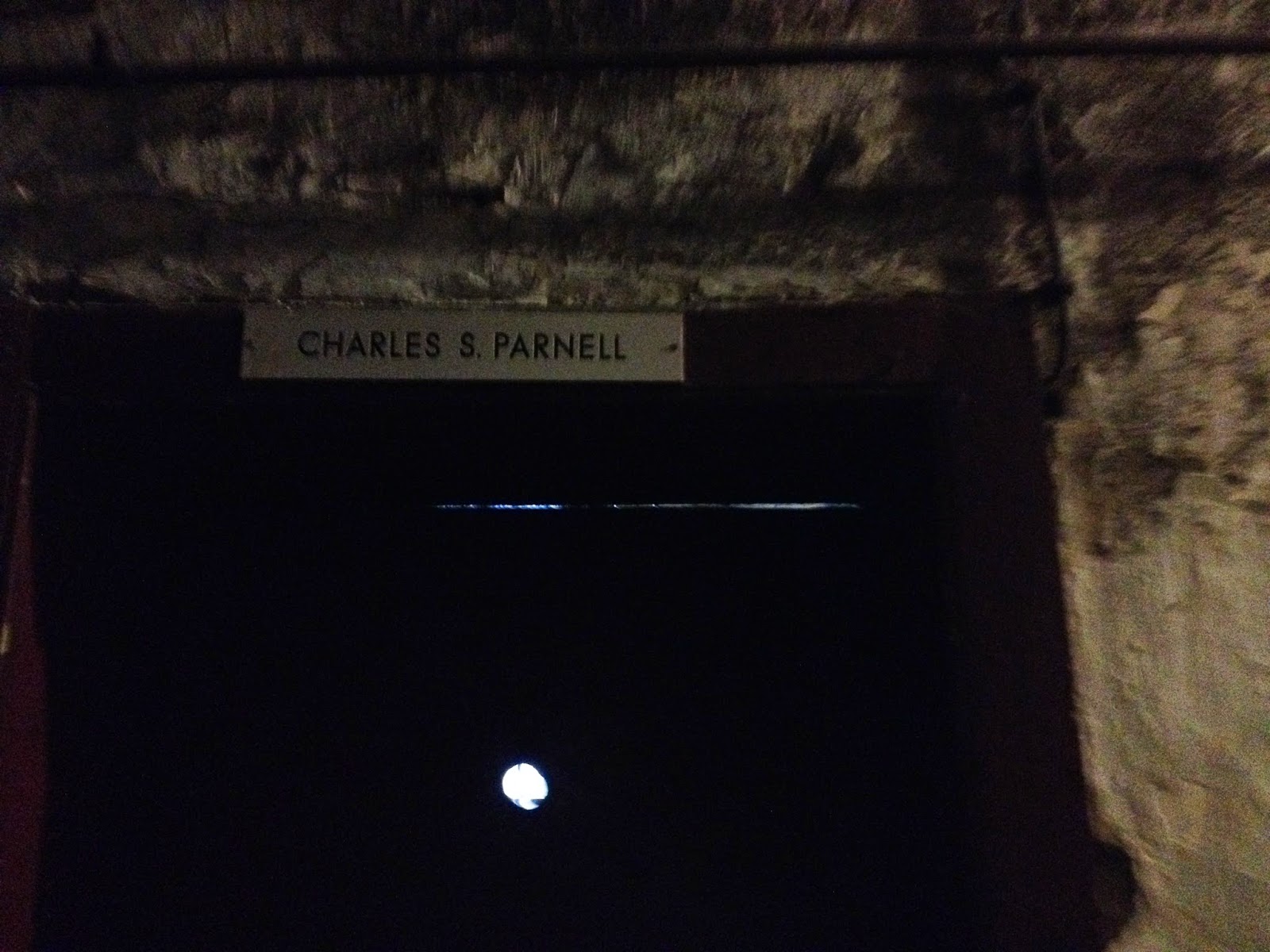
It was not 10 o’clock, and the next tour was not till 10:30, but we were allowed to wander through the museum about the Gaol while we waited for our tour. When it was built in 1796, Kilmainham Gaol was top of the line, very different from the jails that had come before it. Before this period, jails had simply been large rooms where people stayed; thieves and murders mixed with petty criminals. But for the first time, there were jails like we have today; one man to a cell and guards watching over at all times.  Over the 128 years Kilmainham served as a prison, its cells held many of the most famous people involved in the campaign for Irish independence. In the 19th century, it would house Charles Stewart Parnell, who tried to get the First Home Rule Bill passed, and Robert Emmet in the 18th century, whose failed rebellion would get him a death sentence. The British imprisoned and executed the leaders of the 1916 Easter Rising here including Padraig Pearse, Joseph Plunkett and Thomas Clarke. Kilmainham Gaol was closed as a prison in 1924, by the government of the new Irish Free State. 

I saw this advertisement for Glasnevin Cemetery on the bus. The 27 Biggs, 18 Fellows refers to Michael Collins nickname, Big Fellah, but it just got to show how important these past political figures still are in present day Ireland. Michael Collins was in charge of the Free State after the 1922 Treaty and imprisoned many people in Kilmainham Gaol. More people would be executed by the Free State during the Civil War, than by the British during the War for Independence.  

This graph in the museum shows how many people came into Kilmainham Gaol each year. The large peaks you see are during the famine years when the average number of prisoners rose from 1-2 thousand to around 9 thousand due to food related crimes. Prison cells designed for one man would sometimes hold up to ten due to overcrowding.
The east wing, built in the Victorian era. Designed so that one or two guards could watch as many prisoners as possible.

Grace Plunkett's husband Joseph was executed along with the other leaders of the Easter Rising in 1916. They were married in prison the day before his execution. In 1923, Grace was imprisoned by the Free State for anti-treaty propaganda. She painted this mural in her cell.

The West Wing, is one of the oldest in the Gaol. All the leaders of the 1916 Easter Rising were imprisoned here. All 16 that would be executed were held here. More had been sentenced to death, but the outrage caused by the executions caused them to be stayed. Eamon de Valera, who would later be President and Prime Minister, along with anit-treaty leader, was the next to be executed. Before the executions, most Irish did not support the Easter Rising, but afterward the men were considered martyrs.
A plaque in the yard honours those that were executed after the Rising. There is also two black crosses and an Irish flag. As we all know, the Irish flag is green, white, and orange. The green stands for Irish republicanism and nationalism, the Orange for unionism and Ulster, the white the the peace that is prayed will be between them. Today, July 12, is the holiday honouring the Battle of the Boyne. Typically there are marches, bonfires, and violence in Belfast due to these commemorations. Much of the news this past week has been about how people hope that there will be no violence tonight as Protestants march through Catholic neighborhoods in Belfast.


Down on the Farm


After we left the Hill of Tara (and yes, I know that I didn’t do Part One and Part Two like I normally do, but I couldn’t think of a good title for both) we made our way to Causey Farm. Causey Farm is a “fun based venue for a variety of entertainment, tourism, and educational programs,” according to their website. They are, obviously, a farm and they allow groups to do a variety of farm and Irish based activities. I knew from the beginning that it was going to be a bit touristy based on the information that we had received from UCD in an email. We were going to be doing/seeing: a sheepdog demonstration, hurling (a traditional Irish sport), baking, milking a cow, meeting farm animals, bog jumping (more on that later), and playing a bodhran (an Irish drum). We arrived about noon, and we were immediately herded us into our first activity. It was not terrible structured as there were dozens of things we could do, so they let us pick throughout the day.

Causey Farm
We were given a sheepdog demonstration, which was not quite as impressive as it was as Russborough, but it was still pretty cool. We stood in a circle around the sheep while Matt (the owner of Causey) talked to us. Being that close to the sheep was a bit intimidating actually.

There are tons of animals on the farm: pigs, chickens, donkeys, horses, dogs, sheep, geese.

Before lunch (and we were starving at this point) we were taught how to make soda bread. It was very simple, only six ingredients (flour, cornmeal, soda, salt, one egg, milk). We let it cook and we had it with our lunch of vegetable soup. I have to say, Alyssa and I made a pretty delicious bread. Lunch was followed by tea, coffee, and scones with jam and cream. Everything they serve they make themselves by hand, delicious.

An adorable lamb. We were allowed to hold it, but it went to the bathroom on my friend Julie, so no one tried to hold it after that.

We were taught how to milk a cow and allowed to try one by one. This took a while, so everyone wandered around the farm as they finished and checked out the various animals. At the end, after everyone who wanted to had milked the cow; I had elected not too because I did not want to touch the farm animals), Kevin--our guide--asked us if we wanted to try the cow's milk. My friends and I decided to try. So, we stood very close to the cow, and Kevin squirted us into our mouth. It is something I cannot believe that I did. It was warm, which is apparently what everyone says, but it tasted like milk.

After lunch we learned how to play a bodhran, which is a traditional Irish drum. It was not too hard to play and we had fun doing it. Then they taught us a ceili, which is Irish dancing. I hate dancing, I really do, but we were all forced to do it. It is line dancing, and involved spinning and keeping time with a rhythm. I did awful, and stepped on quite a few feet. It was really bad; quite embarrassing, and hard since the music got faster and faster as we went.
One of the things that they had promised we could do, is bog jumping. A bog is basically like a swamp, except less watery. If we wanted to do it, we had to bring a towel and extra clothes because you are basically swimming in mud and get absolutely filthy. I elected not to, but my friends Julie and Alyssa did, and they got really dirty. The bog is very cement-like and hard to get out of, almost like quick sand. This bog was designed for people to swim in, but it is very dangerous to walk in a bog area as you can get sucked into a bog that might be several metres deep and not able to get out.

While the bog jumpers were getting cleaned up, we explored the farm and looked at the farm animals. Then they showed us how to play hurling. Hurling is one of Ireland's two national sports (along with Gaelic football) and is a lot like lacrosse and baseball. After this we were given a lovely dinner of cabbage, carrots, mashed potatoes (and ham, though I obviously did not partake ), with apple crumble for dessert. It was quite a long and exhausting day.

The High Kings of Ireland


UCD had another cultural programming event on Friday to the Hill of Tara and Causey Farm. I had to be there at 8:30, so it was an early one, but it was not too difficult getting there since it was a Friday and there was a lot of buses running at rush hour and they were coming frequently enough. When I got to UCD I found my friend Julie, who also lives off campus, and we tried to find where we were supposed to catch the bus. We had been told that our chaperons would be there at 8:15, but they were not, and for a bit Julie and I were pretty sure that we were in the wrong place. Eventually our guides showed up, along with the rest of our group, and we were off to the Hill of Tara in County Meath.
      The area where the Hill of Tara is located is of immense importance in Irish history. It has been used since the Neolithic era, and has been used as a religious and political centre. It was here that that high kings of Ireland were crowned for hundreds of years. From the parking lot it does not look like much, but as you enter what looks like a normal, unkempt field, you become aware that this is not just another hill part of Ireland. We were only there for a short time but I could feel the historical significance. Most of the history that I have been learning is about the British and Ireland, but this place is so much older than that.

An aerial picture of the Hill of Tara
As you walk in the field you are surrounded on either side by mounds (like walking in a very large ditch). In the times of the High Kings, the walls would have been very high and you would not have been able to see over them until you get to the end where you can see in all four directions. This was a part of the ceremony as the new king's procession brought him to Tara.

Mound of the Hostages, though it never held hostages. It is a passage tomb constructed around 3,400 BC (older than the pyramids). The cremated boys of dead were put in the tomb along with some belongings. On Samhain and Imbolc, two Celtic holidays, the tomb is illuminated by the sun.

Rath of the Synods; a ring fort with three banks. It was mostly destroyed in the 19th century when a group called the British-Israelites dug there in a quest to find the Ark of the Covenant between 1899 and 1902 after misinterpreting ancient texts.
The Stone of Destiny, the coronation stone, said to scream when the hand of the true High King touched it.

A fairy or holy tree. People tie ribbons or other objects to it in the hopes that the fairies or God will answer their prayers. 

It is said that St.Patrick Visited the Hill of Tara after lighting the Paschal fire in the 430s, which convinced the High King of Ireland to convert to Christianity. There is now a church next to the Hill of Tara called St. Patrick's.
 

To the Theatre


You might or might not remember from an earlier post that on our first day here Alana got to slap an Irishman for a play's promotional. It was a long time ago, I know; I cannot believe that I have been here for over a month. Well, this play The Boyz of Harcourt Street is now showing, so after Alana consulted with the actor that she had slapped, we decided to go on Wednesday. The show was to start at 8:30, so Alana and I made our way to the city centre at about seven and we arrived at Smock Alley a half hour later. The theatre is quite old and originally opened in 1662. It is situated along the Liffey River so I have often run past it. When we arrived though, Alana and I immediately realized that something was going on.
There were limos and security and a red carpet of sorts. Walking inside (and let me tell you, I was not sure we were going to be able to get inside) we made our way to the box office. We bought our tickets for the play, and decided to ask what exactly was going on. Apparently the Best of Dublin Awards sponsored by 98fm was going on and all of Ireland’s celebrities were there (not that we recognized any of them…). The Best of Dublin Awards honours Dublin’s best, for example: Best Landmark, Best Family Spot, Best Pint. “Did you see those identical twin lads on your way in?” the box office seller asked us as we talked to her.
“Yes,” we answered confused. We had past them alright, and they were currently getting their picture taken against the red carpet behind us.
“Those are Irish pop singers, very famous,” she told us, and Alana and I immediately turned to look at them. They definitely looked like pop singers, whose fan demographic was 12 to 15 year old girls. For a long time Alana and I stood there, debating whether we should ask for a picture or not.
“We don’t even know who they are,” she argued, while I thought they really wouldn’t care, that they probably loved getting their photo taken. Eventually we chickened out and left, going to a pub down the street since the play wasn’t for another hour. On the way out I snapped a picture of them as sneakily as I could. While we were there we asked some Irish guys who were sitting at the pub with us if they knew who they Irish pop singers were, and they immediately knew who we were talking about.
“Jedward,” they had said with disgust. “They are like Justin Bieber, but worse.” Alana and I could not figure out how someone could be worse than Justin Bieber, but a quick Wikipedia search told us that they had been on British X Factor.
At 8:30, Alana and I were allowed into a side theatre since the main one was being used for the awards. It was small, only about 50 seats, but decent. There was no stage, no set, no props. The ‘dance comedy’ as it was advertised, had a cast of three, with another person creating music and sound effects on the side. It was basically making fun of the people who go to Harcourt Street clubs, which is notorious in Dublin for crazy and wild parties and drinking; the clubs there are truly infamous. It was terribly funny, very raunchy, but entertaining. We left having laughed for an hour straight.